About Me
About this Site
Curriculum Vitae
Archives
Expert Witnessing
For my Students

Note: here I chronicle the march that took place in Tegucigalpa (and around the country) a week and a day before last Wednesday's horrible repression in San Pedro that took at least one life and directly attacked art and freedom of expression in Honduras.
I got up early, 6:30ish, and took a cab toward the UNAH, where I had heard people were gathering for the paro cívico. At a stoplight I noticed that El Heraldo was continuing its really important [except sometimes I forget that you can't read my sarcasm on the screen] story about young Honduran women! Being sold into sexual slavery in Guatemala! We don't have any real evidence, but let's show you what a really sexy slave might look like!
Previous day's paper:

At stoplight:

God forbid El Heraldo, so sympathetic to Honduran migrants abroad (especially young sexy ones who are violated in ways they hate to—but must—imagine in painstaking and sordid detail), investigate the roots of emigration. God forbid they discover that Canahuati, the owner, financed and whitewashed a military coup, usurping Hondurans' democracy and along with it their lands, their water and their education, and leaving many of them little chance but to flee the country for survival.
The taxi let me off by the U, and I took a photograph of one of the main message of the walls for this month:

I didn't see the crowd I'd expected, but I crossed the pedestrian bridge to get a closer look. I took a picture of the automobile entrance from above. The gates were closed, with a police car on the outside and soldiers on the inside, and a number of people crowded around.

I got down there. I was a little nervous to take pictures, but went ahead. Here's a soldier looking out from within the locked gates:

A number of workers who needed to get in, but because the U was on military lockdown, were having trouble with that.

People I knew from this summer, sitting on the back of a police car. It was an oddly relaxed atmosphere, given the stakes.

A view from in front of the police car at the locked gates of the militarized university:

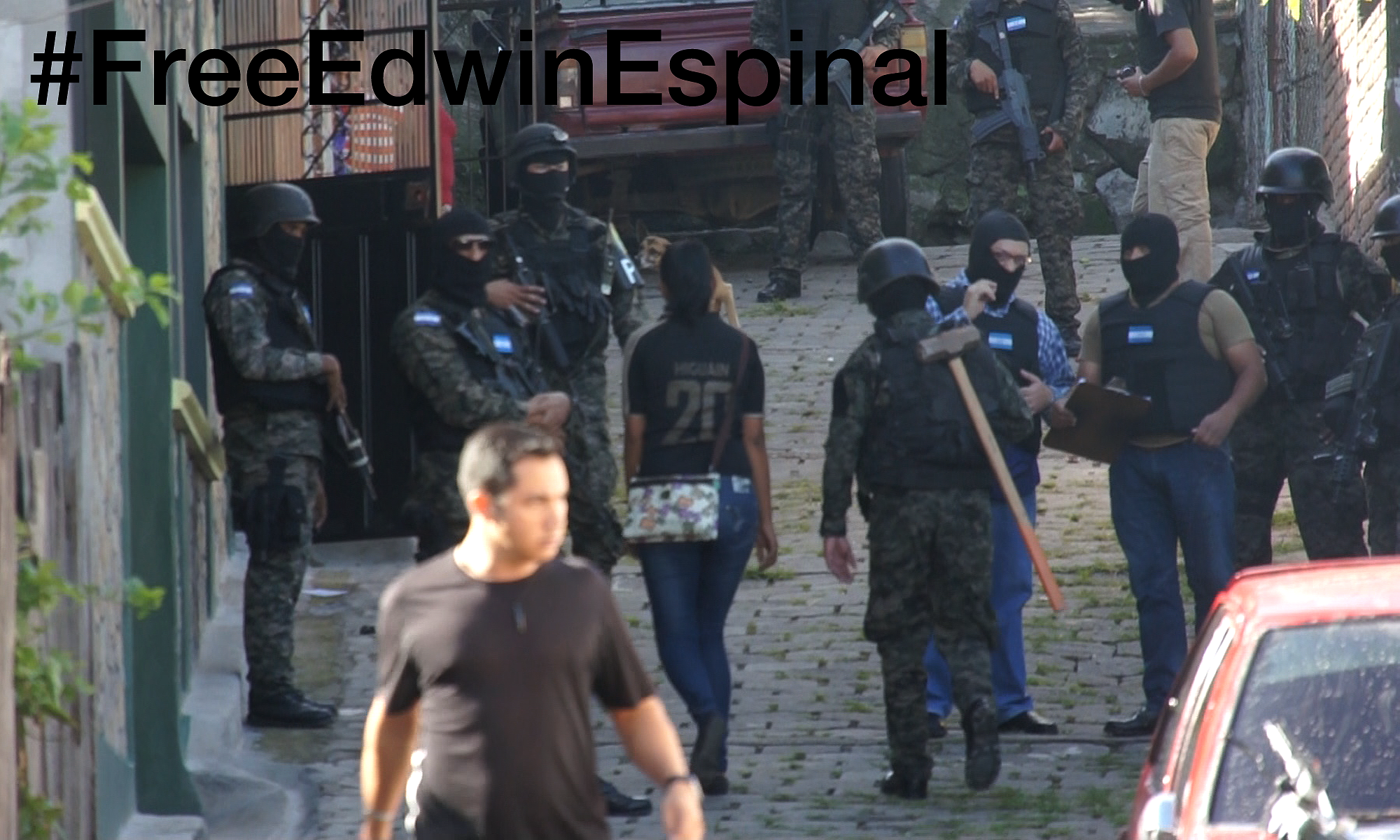
I then walked up to the main pedestrian entrance to the University, which was also locked. Numerous soldier milled about, carrying various weapons, but also sizeable wooden planks and bats.

Why were the military there? The Heraldo was busy making the case. It was thin. One of the many articles on the topic was titled Buscan explosivos en Ciudad Universitaria—"[The military] seeks explosives on the University Grounds." Probably, not that many people read past the headline to the article's admission that:
"No encontramos ningún artefacto que contuviera material explosivo, pero para salvaguardar la vida de las personas que se encuentran en las instalaciones se hizo la inspección", declaró uno de los especialistas.
"We didn't find anything that contained explosive material, but in order to protect the lives of the people in the buildings we carried out the inspection," declared one of the specialists.
I decided to head down to the Universidad Pedagógica, and got a cab by the gate. On the way, a few blocks down a different street I hadn't passed by on my way there, I saw that the crowd was still gathering and hadn't yet headed up to the university.
I was dropped off at the back entrance to the UPNFM,where classes seemed to be in session. Students and faculty were milling about. At the front exit across from Mall Multiplaza, I saw the crowd gathering. It wasn't massive, but it was still early. The original grandmother of the resistance showed up with her bullhorm and injected her spirit and enthusiasm into the milling crowd.
¿Están cansados? she bullhorned (are you tired?)
¡NO! people happily responded
¿Tienen miedo? she followed (are you afraid?)
¡NO! the answer came, more loudly
¿Entonces? (Well Then?)
The crowd responded: ¡Adelante, adelante, que la lucha es constante! (Go forward, go on, the stuggle is constant/ongoing)
She greeted many friends as she walked along:

A number of vendors had set up, and cars could still make it through. The march had been convened a little too early in the morning for most Hondurans, so those of us there ate baleadas from the resistance vendors, bought swag, and greeted friends while waiting for a critical mass.

The grandmother continued her cheerleading march through the crowd, here on a pause:

In order to take this picture without being rude, I bought a lighter

...that was made in China.

The union for the workers of the Ministry of Arts, Culture and Sports was present, in defiance of Bernard Martínez, their golpista boss.

Somebody was suddenly motioning to me to come over, and I saw Félix Molina next to him. Félix finished the interview he was doing and thrust the mic in my face. "We're live on Radio Progreso," he said. He asked me a few very leading questions about the State Department's complicity in violence being carried out against Hondurans, and I answered the softballs accordingly (i.e., truthfully). I made the tactical error, when asked how the crowd looked to me, of saying it could be bigger and that pointed to a need for constant organization there, just as we need to be constantly organizing in Washington. I know you're never supposed to say that as a mobilizer, but I had my anthropologist's hat on at the moment. Actually, I ironically (given that I am loathe to serve as a billboard for consumer products) had on a black Pabst Blue Ribbon hat my favorite brother gave me, but that's neither here nor there. In any case, the crowd rapidly grew soon afterward, putting some of my concerns to rest.
Still outside, I took some more pictures of my surroundings. Morazán stencils, and tags of "FERNO" are newly all over town. I don't know what the latter means, and neither did any of my friends, although I'm guessing it has something to do with the education struggles.

This FERNO Morazán appeared to be crying. FERNO/ Forging student struggles:

I was trying to get a shot of this woman's Che backpack (his fetishization has gone through the roof), and only after taking the photo realized the concerned group was gathered around a man who appeared to be passed out, and were trying to revive him.

Another resistance vendor display:

...and some Che stickers. "We have hopes because we have love. Made in china"

I ran into some good friends with the artists in resistance. One of them was wearing his martyrs tee, and exclaimed to a few of us: "I fucked up! I forgot to bring another t-shirt to change in to!" Another of his friends laughed and said "I have mine right here in my bag."
After a year of protests, last year every single day, people have a kit and a routine. And one of the things everyone knows to do is bring two sets of clothing: resistance gear for the crowd, and clothes less likely to get you arrested once it disperses.
Some young people prepared a stencil:
Freedom to think, to speak, to live

The crowd grew as the minutes went by, and the loudspeaker pickup truck drove slowly through making announcements:

Sombreros were a big item, and this vendor displays the usual transport mechanism for this type of merchandise:

I greeted Juan Barahona, who was making the rounds among the crowd. Carlos H. Reyes was also present:

Anyone who's "full" resistance has to own their own copy of Quien Dijo Miedo:

...and the march began. I climbed partway up the overpass for the view. I wasn't the first to come up with the idea, as you can see in the last of this series of four shots. I also had to contend with an impressive display of cables that tell a story about public infrastructure on their own right.


I went down to talk to people at the march. The Feminists in Resistance were front and center, as usual.

Resistance vendors sold hats and ice cream:

Numerous marchers were also filming and taking pictures:

This banner was from the "Red June" concert on the coup anniversary earlier this year:

This group of nurses in resistance posed for me:

Here is what the Rodrigo Wong Arévalo's "Abriendo Brecha" telencuesta (television survey) asked following their announced participation:
¿Cómo considera usted el que los doctores y enfermeras abandonen los hospitales para participar en el Paro Cívico del martes?
- Lucha de derecho
- Acto inhumano
Do you think that doctors and nurses abandoning their hospitals to participate in the work stoppage on Tuesday are engaged in:
- a fight for their rights
- an inhuman act
Take a look at this telencuesta from the following day, courtesy of my friend Toño:

Translated:
What measure would you support to combat criminality in the country?
Really. That's the median level of golpista media discourse.
This graffiti message read:
(Top)The power is in the streets
(Under that)28 years after the kidnapping and murder of Felix Martinez we vow to win, signed [something of] Morazán, MIR/URP

TV Globo was filming from the loudspeaker pickup, while speeches were made:

...of course, the golpista media, as usual, prefered to interview Emo, because he fits their stereotype of crazy foreign resistance infiltrator:

Some gringos were filming by a tag announcing the presence of "Rockers in Resistance":

Another abuela was being interviewed, and a chicle vendor with an interesting prop went up to listen, while the folks in the background sought shade from the beating sun:

I wandered back through the march, which was more of a paro than a march. The bridge was taken, and no one seemed to be going much of anywhere. This particularly Frank Chu-ian sign (although much more coherent, in a normative sense) poetically read:
And so we go...
writing and
building
a new
HISTORY
with
FNRP
blood
sweat
tears
and ideas
for love of
HONDURAS
We inform you that
1,057,481 [of us]
have said
Yes to the constituent assembly
Thank you, brother and sister countries


I was going to head back to the hotel to start writing up, but at the edge of the march ran into a young friend on the FNRP communications committee. She told me she and her friend were heading off to the other march at the UNAH, so I decided to tag along.
The taxi dropped us off more or less where I had been dropped off earlier that morning, just by the university entrance, but this time the scene was very different. As I exited the cab, I saw young men, bandanas covering their faces taking turns running and kicking signs advertising various golpista enterprise. So without thinking I took out my camera and started taking pictures. Big mistake. Immediately three men came running toward me, seething with hostility. "Are you with the CIA?" they demanded. "You're with the CIA! LOOK- she's with the CIA!" I protested that I was not at all with the CIA, that I was very sorry, but they cut me off—"but you're a foreigner, right! Why are you taking pictures? Eso no se hace."
My Honduran friends brushed it off, but I went into a full-scale panic. I felt like my gut had turned inside out. How could I have been so stupid? A friend tried to calm me down. "What's the problem with you taking pictures?", she said. "Other people are doing it." But there was a big problem with my taking pictures. They didn't know me. They didn't know what I was going to do with them, why I was there, if indeed I was collecting intelligence for a hostile agency. Even journalists, including some from Radio América, have taken pictures and turned them over to the police. People have been killed by the Honduran military and police, because of other people taking pictures. My first reaction was to flee, fearing that my continued presence would only provoke them more. But there was nowhere to go. The road from the university is long and has few exits. I thought despondently about gringos I know who have acted imprudently and been exiled from the Honduran resistance. I know better than to think I can act like I belong. My face, my accent, my mannerisms preclude that ever being a possibility. And that's fine. But it also means I have to respect the internal security norms far more than even a Honduran might. Because of what my government and U.S. industry have done to Honduras, because of what the Israeli and Canadian governments and industry have done to Honduras, because anthropologists work for human terrain systems, because academics are rarely intellectuals in the Sartrian sense, because I am not a journalist, I am suspect.
I vowed not to take my camera out again, and lowered my head, trying to not be captured by the many other video and still cameras shooting in my direction. But then I heard my name being called. It was Ricardo Salgado, a friend whose analyses I very much admire (here's the latest, and an earlier translation I did). I went over and we kissed hello. He was standing with Rasel Tomé who greeted me as if we knew each other. We engaged in a few moments of small talk about the march, and then I told them what had happened, hoping, perhaps, that somehow it could be could explained to the people who had accused me earlier that I really meant no harm, that I would happily erase the pictures, that they were right that I had no business taking them, that I was a total idiot. [As I said this we walked past a large group of the same youths I'd earlier photographed, lowering a Honduran flag on the median to half-mast, and raising a resistance flag. I wanted to take the photo so bad].
Not long thereafter the man who had accused be of being CIA came over. "Do you know her?" he demanded of Tomé, who faltered. He couldn't vouch for me, after all, since he'd only just officially met me, but he said I was a friend of Ricardo's. I tried to apologize, and to explain that I was stupid, and my earlier accuser explained back, apparently accepting my apology and saying they always welcomed solidarity, but that they had to be careful, that there was a lot of danger, that people were getting killed. Rasel offered to watch as I deleted the pictures, and at that moment, regardless of anything I may have written about him in the past, I loved him more than anyone else in the world. The sun was so bright that there's no way he could have actually made out what was on the screen, but I deleted them all, and he confirmed to the others that I did so.
A young man who had watched the interaction, and who seemed to know Rasel and the others came by and walked with me. He introduced himself as Guillermo, a radio announcer. Feeling confessional (and that openness might serve to protect me), I told him what had happened as well. He was nice company, so I walked with him for the rest of the march, making sure to ask him every time I considered taking a picture—both to get his opinion and also so that I'd have a witness.
Despite my efforts, as soon as I got home that evening I was horrified to see that one of my resistance "friends" (in quotes because so many of them I don't know in person, or have profile names like "Juan Resistance") had posted numerous photos of the sort I had taken on Facebook, with the question "is this the resistance we want?" I immediately worried I'd be pegged as the photographer, despite the fact that I couldn't have taken the pictures, both because I had my camera in my bag at all times except for the photos shown below, and because I'm way less talented of a photographer. The pictures were also published by El Heraldo, who dramatically labeled the various acts as Terrorism Against the Media, a kind of ironic charge, since you might think that the targeted assassination of 10 journalists so far this year would elicit a greater reaction from the media than victimless property damage. But Guillermo, who'd already "friended" me by that evening, assured me repeatedly that he'd vouch for me, having walked with me the entire time, and in the subsequent weeks no such accusations have arisen—after all, the Heraldo photographer who took the pictures presumably got the credit.
I don't know whether the young men throwing rocks at the windows of the Torre de la Libertad (of Rodrigo Wong Arévalo, mentioned above), CONADEH (The National Commission for Human Rights, presided over by Ramón Custodio, who has worked harder to further human rights violations in the name of constitutionality for his fellow golpistas than just about anyone), and Televicentro, the coup mouthpiece of Ferrari, were impostors as resistance leaders claimed. One young friend told me that her cousin, a soccer gang member not particularly resistance-identified but into fucking shit up, was among them, along with many of his friends. Each time they began throwing rocks, numerous people in the march (including those who had yelled at me earlier) would yell at them to stop, and failing in that, would yell much louder to them to avoid harming any people, and the rock throwers seemed to take those admonitions, at least, quite seriously, avoiding guards in particular. Seeing the youths with their faces covered throwing rocks, a few other protesters occasionally joined in without realizing that their uncovered faces, plastered all over the media they were finally fighting back (after so long being attacked) would put them in grave danger. I noticed also that Televicentro had locked its doors when the rock throwers approached, not permitting their own guard to enter the building. Whoever they were, El Heraldo's description of them as mareros zelayistas is woefully inaccurate. I suspect there was a mix of people involved with a variety of (largely legitimate) motives, but I doubt any of them would have self-defined as Zelayists, and the marero descriptor is similarly untrustworthy, since it's generally used to write off anyone El Heraldo wants "cleansed" a la Ricardo Maduro and Oscar Alvarez's Cero tolerancia and Mano Dura, a la Lobo's Ley Antimaras.
What I do know is that the news that Wong Arevalo, Custodio, and Ferrari's glass houses had been smashed was received with delight among many within the resistance who would not themselves take such measures, even as it was used to further demonize the movement by the same media. Even an OAS representative I spoke with a week later in DC grinned in glee upon hearing the news. "It's about time," he said, chuckling.
It's worth noting that El Tiempo's coverage was markedly different from El Heraldo's. Workers demand a Constituent Assembly and minimum wage hike, its headline read. It only mentioned the targeted property destruction as what it was- a small part of a much larger rejection of economic and political State violence. In any case, El Tiempo was much more busy attacking Asfura and his Channel 8 manueverings.
Dick and Mirian Emanuelsson did—as usual—an excellent job of exploring the motives behind the march and the property damage in their video and article in Vos El Soberano, Multitudinaria manifestaciones en el Día del Paro Cívico Nacional. They explain:
The third stop for the rebellious youth was the elegant headquarters of the National Commissioner for Human Rights, Ramón Custodio, appointed by the National Congress and also known as "rubber bullets." He earned this nickname when he claimed that the bullets that killed the 19-year old youth [Isy] Obed Murillo at the Toncontin airport on July 5th, 2009, were "rubber" bullets. Now the youths that finished off the windows of Mr. Rubber are defending themselves by arguing that they didn't do so with stones-stones, but with rubber stones.
Despite all the hooplah over a few dozen broken windows in media outlets and a "human rights" office that are both directly and indirectly responsible for the murders, disappearance and torture of resistance activists through financing the military coup and unrelentingly promoting it, that did not turn out to be the biggest news item that day. Terror in shoe factory trumped the "terrorism" in the Heraldo. In El Tiempo, a particularly apt cartoon about the coverage of the massacre, in which Oscar Alvarez came out suspiciously quickly with investigative claims that blamed the victims:
As a poor person, one must not let oneself be killed by any old assassin...because I have noticed that the investigative hypothesis will be that we were mixed up in drugs...
So as I continued walking with Guillermo, he let me know when it was appropriate to take more pictures.
There was this one of Rasel Tomé getting interviewed. He was skewered in El Heraldo as somehow "leading" the so-called "mareros zelayistas"—utter nonsense, as both parties completely ignored each other.

This picture, taken outside COLPROSUMAH headquarters, I took in terror, with Guillermo encouraging me to get closer, zoom. I took it in terror because I had already used up my quota of adrenalin from the earlier CIA scare, and then just before someone pointed out this particular band of soldiers, there had been a huge commotion at the start of the bridge. Jumpy from trying to stay away from the cameras (to not be accused of being a foreign infiltrator by either side—I swore this would be my last march) and the rocks, I was jostled toward the edge of the bridge to see what was going on in the grassy area below. A number of people, including a news camera woman, were hiding defensively behind the edge of the opening (still on the grass) that went under the bridge, pointing and telling us that the police on the other sides were pointing their guns at them. The camerawoman leaned out ever so slightly and shouted at the top of her lungs "¡HIJOS DE PUTA! Are you going to shoot at us? Are you?" I was trying to walk with my head lowered, as close to the middle of the road as possible, as if somehow those ten feet or so would protect me when I had police guns trained on me on one side, military on the other. So anyway it was at that moment when Guillermo insisted I take the shot of the military, which actually got me to snap out of the terror a little bit. If he thought it was fine, I didn't have to be so scared...right?


A little bit later we saw a larger number of soldiers stationed outside the Presidential residence.

One of them, a woman on the right of the formation, kept waving for us to come on over. It was a challenge; she wanted a fight. One or two rocks may have been thrown, I don't know. In any case, we really didn't want that fight.

Just after we safely passed those soldiers, I saw this great Ferrari pig. I'm seeing artistic talent develop as the months of graffiti go by. It was spray-painted over a misspelled declaration that "The People Will Win."

At some point soon thereafter, somewhere near the Clarion Hotel, we met up with the larger march that I'd been at earlier. It was a festive reunion, and I ran into friend after friend, and met some new people as well. One of the latter was a young gringo (or perhaps Canadian) named Ian who told me about the documentary he was making about the coup and the soccer angle—without defining exactly what he meant by the "soccer angle." He spoke of having spent many months in the country, and his interest in speaking to all sides. So far, so good. And he was nice enough. But the way he spoke about his film, in a sort of "neutral" pseudo-journalistic language without convincing me that he understood or cared about what is at stake for Hondurans, made me not really want to give him the interview he was trying to squeeze out of me. Now, having poked around his website thehondurasfilm.com and seen some of the previews, I think I made the right decision.
Heading finally toward the center on what by now had been quite a long walk in the sun (my shoulders were red as beets by the end of the day), we came upon the Feminine Police Station. It was a tense standoff, and these really poorly shot photos give you a little bit of a sense of it. They stood there in formation, obviously with clear orders to not react, while the crowd jeered at them. "Estudiar, aprender, para chepo nunca ser," they chanted over and over, "Study, learn, to never [have to] be a cop." A young friend from a very poor background who had been marching next to us at that moment told me later on that he was ashamed of the crowd at that moment. He understood why people were angry at the cops, but it's just not so simple. The police come from poor families like his, he said. Many of them don't have the chance to study. Are they stupid because they are poor? It's not that the police force is any good, it's an enemy of the people, but it's not the fault of the recruits. Imagine how that must feel, having the whole crowd shout at you like that, when you're only trying to make enough money to eat.
It's a hard one. I go through similar back-and-forths with myself about U.S. soldiers, not wanting to demonize them for being victims of structural violence and ideology, but at the same time, in recognizing their agency and (even if minimal) choice in the matter, finding it necessary to place some degree of blame. In any case, the question of class is too often and too easily elided by righteous resisters even as they (particularly college students) identify as/with the oppressed classes and rail against the bourgeoisie. My friend's argument gave me pause.


Walking past the Edificio Rojo, I saw some friends dancing punta to a drumbeat.

They were having a great time. Then just behind them I noticed my friend whose sister had been killed the previous week in what was surely an attempt to get him to shut up, smiling at the dance. I went over and he greeted me with a smile. I hugged him, and said "I am so sorry about your sister." He looked at me, momentarily revealing the smile as a fragile mask. "Who told you?" he asked, and I said it had been a mutual friend. Putting his smile back on, he said "Oh well, it is what we've come to expect; we have to go on living, we have to keep resisting."
There's a lot I don't understand about grief, but some of what I (rightly or wrongly) assumed my friend to be not expressing, I felt at that moment for him.
At the bottom of the hill, the kids at the Instituto Honduras were thrilled to see the march go by (in this case, former Zelaya minister and economic adviser Nelson Ávila and friends), and waved enthusiastically:

We made it up the hill, past the storefronts that looked so different every other day, and up to the city's central plaza with its graffitied cathedral, and turned the corner. This man led the sunburned marchers:

As we finally made our way up to the Congress, the mood was festive, in part thanks to the resistance punta artists there. For some reason that I can't be bothered to further investigate, this short video, which despite being shot in the wrong direction looks crystal clear on my computer screen, got mangled in the upload to youtube. But you get the idea.
The punta artists paused, and the whole crowd began to sing the national anthem.

This is a common feature of any protest. Here's a video of a similar event posted June 30, 2010, where Hondurans gathered as the nascent resistance movement outside the Congress to condemn the then very recent coup:
...and the blanquitos coup supporters, who came out in much smaller numbers throughout last year (and then when the State Department secured their victory, ceased to exist as such), significantly more off-key and visibly upper class, posted on July 2, 2009:
Now, thankfully, resistance marchers have a much more beautiful version of the anthem to sing, as interpreted by Karla Lara. To my dismay, I have not been able to find a version of Lara's interpretation on youtube to embed here, although you can hear it at the beginning of Félix's program on Radio Globo every day.
A couple views of what the National Congress looked like right then. In the first, you can see the sign earlier featured outside the Pedagógica, and COPINH signs:

...and this one gives you a sense of the militarization of the Congress.

More television interviews/reporting:

...and a view from up on the platform adjacent to the bajos del Congreso, giving a view of the solid block of soldiers. It felt like Cairo:

Berta Cáceres of COPINH gave a rousing speech:

And then I noticed this guy:

Didn't see him? Take a closer look. This gringo, trademark smirk on his face, was in some kind of charge.

Gringo soldiers are often in these situations, ones that you really wouldn't think ought to pertain to them. Legally, that is...of course, we have the School of the Americas as evidence that counterinsurgency warfare against domestic Latin American populations is a huge priority for the U.S. military and State Department. Here's a photo taken by solidarity worker Tanya O'Carroll earlier this year.

In Tanya's words:
[The picture] was taken at the March of the Sombreros on the 15th March, by the road block outside the casa presidential.
I saw him more than once. The first time was when I took the photo, the second was on the anniversary of the coup this year. He was standing with the military on the grass verges above the main protest. The crowd noticed him and immediately identified him as a gringo and began to shout. It caused a commotion and a couple of journalists approached him which wiped the smirk off his face and he was quickly moved back behind the main line of soldiers.
Right around that point I was sitting on a stair and felt someone brush against my bag. To avoid getting anything stolen by the young woman sitting next to me (I'm constantly being chastised for not being careful enough) I moved my handbag to the other side. I found out once I finally wandered away from the crowds and made it to lunch that I was too late; she'd swiped my phone. Normally when something of mine is stolen, even something small, I suffer a profound sense of betrayal, but this time all I could do was laugh. After all the effort I'd gone through to evade the military, switching out my tapped SIM card, buying a black-market chip, not storing numbers...after all that, my piece-of-crap phone gets stolen at a resistance march. I think it's likely that pickpockets (resistance or not) would find the marches rich in possibility, especially with trusting foreigners who leave their phones in the outside pockets of their bags. By the time I figured out it was gone and called my phone, my new chip had been removed and was gone forever. Of all the things they could have taken, at this stage, it was the least important, and I felt especially happy at that moment to have my cameras and wallet.
On the way back from the center, a few graffiti messages:
Faith cannot be sold:

Shiteletti (referring, por supuesto, to Micheletti):

Amnesty, never!

This wall, on the march's earlier route, already getting a new paint job:

A diparaging reference to Julieta Castellanos:

...and finally, a heartfelt thank you to the most steadfast and uncorruptable of human rights defenders in Honduras, across the street from their headquarters:

Recent comments
2 days 14 hours ago
6 days 23 min ago
6 weeks 6 days ago
8 weeks 1 day ago
12 weeks 2 days ago
16 weeks 2 days ago
25 weeks 4 days ago
28 weeks 10 hours ago
31 weeks 3 days ago
31 weeks 6 days ago